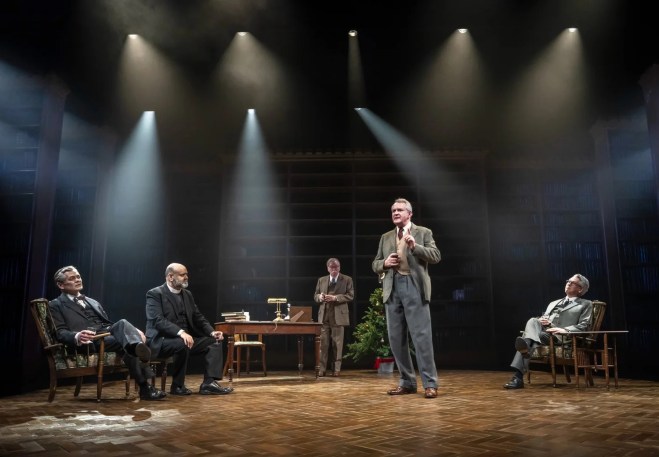
At the Aldwych Theatre, Shadowlands unfolds with a quiet confidence that feels almost radical. There is no spectacle here, no emotional overstatement. Instead, this production leans into intelligence, restraint and precision — and in doing so, becomes quietly devastating. Written by William Nicholson, the play traces the unexpected love between C. S. Lewis and Joy Davidman, and the theological certainty that falters when real suffering enters the room. What makes this revival so affecting is its discipline. It trusts language. It trusts stillness. And above all, it trusts its actors.
At its centre is Hugh Bonneville as Lewis, and he is impeccable. Truly. He doesn’t miss a beat. His performance is built on immaculate control: dry wit delivered with academic rhythm, every line placed with intention. Early on, his Lewis is charmingly assured, intellectually playful — a man entirely at ease in theory. Bonneville’s comic timing is effortless, drawing easy laughter from the Oxford high table scenes without ever tipping into caricature.
What elevates the performance, however, is the slow erosion of that composure. There is no theatrical pivot, no grand emotional rupture. Instead, Bonneville allows the armour to fracture almost invisibly: a hesitation before a sentence; a silence that lingers half a second too long; a voice that tightens when it shouldn’t. When grief arrives, it lands not in melodrama but in stillness. His restraint is precisely what devastates. By the final moments, the intellectual has been stripped of certainty, and Bonneville permits that vulnerability to sit unguarded before us. It is masterclass-level acting.
Opposite him, Maggie Stiff gives Joy Davidman fire and clarity. She is sharp, emotionally direct and wonderfully unsentimental. There is strength in her humour and steel in her warmth. Stiff avoids playing Joy as fragile or saintly; instead, she presents a woman of intellect and conviction who challenges Lewis at every turn. Their chemistry feels earned rather than performed — you believe in the way they spar, the way they soften, the way they gradually find each other. In the second act, her performance carries a quiet courage, resisting easy pathos and allowing dignity to do the heavy lifting.
Jeff Rawle brings textured warmth as Major W. H. Lewis, grounding the production with understated humanity. His presence softens the more philosophical exchanges and provides gentle emotional ballast. There is no weak link; the ensemble work is tight and disciplined.
The transitions are seamless. Scenes bleed into one another almost cinematically, with no jarring resets or clumsy blackouts. Under the elegant direction of Rachel Kavanaugh, time shifts with grace. Conversations glissade into memory. Emotional echoes reverberate across scenes. The pacing is deliberate but never slow, reflective but never indulgent.
Visually, the production is beautifully cohesive. Set and costume design by Peter McKintosh captures Oxford’s academic atmosphere without overwhelming the stage — refined, spacious, quietly evocative. Lighting by Howard Harrison subtly sculpts the emotional temperature, warming the early intellectual exchanges before cooling into something starker as grief takes hold. Sound design by Fergus O’Hare and music by Catherine Jayes sit delicately beneath the action, enhancing rather than instructing the audience’s response. Movement direction from Georgina Lamb ensures the staging flows with quiet precision, contributing to those seamless, almost choreographed transitions.
What makes this Shadowlands exceptional is its refusal to push. It does not beg for tears. It allows silence to breathe. It trusts the audience to sit with discomfort — to question faith, certainty and the cost of loving deeply.
By the final scene, the auditorium is held in complete stillness. Not stunned — reflective. Not manipulated — moved. An intelligent, exquisitely controlled production, anchored by an impeccable Hugh Bonneville and a fiercely compelling Maggie Stiff.
⭐⭐⭐⭐⭐
 STAGE DOOR JOE