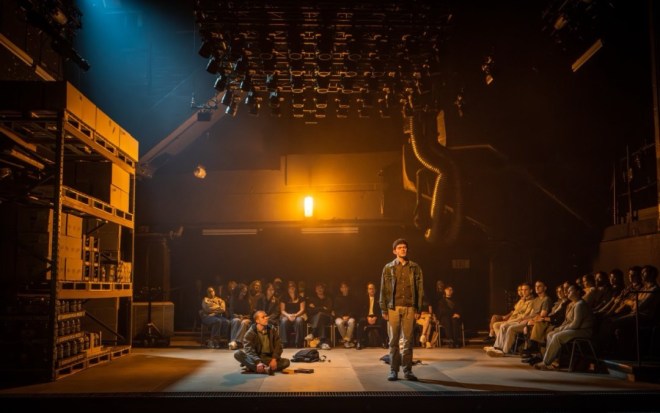
Last night’s performance of Clarkston at Trafalgar Theatre was a quietly devastating reminder of how intimate storytelling can carry enormous weight. Directed with care and precision by Jack Serio, Samuel D. Hunter’s play emerges here as both a study of personal struggle and a broader reflection on the cultural stagnation of small-town America. It is a work built on silence, confession, and the fragile bonds between people who might otherwise be lost.
The production achieves a disarming intimacy, drawing the Trafalgar audience into a space that feels as raw and immediate as a late-night conversation with a stranger. At the centre of this intimacy are two remarkable performances. Joe Locke, in his West End debut as Jake, gives a performance of surprising depth and maturity. He captures the idealism of a young man who wants to seize life with both hands, even as he confronts the crushing inevitability of Huntington’s disease. Locke’s Jake is layered, restless and yearning one moment, brittle and despairing the next. His vulnerability is never overstated, which makes it all the more affecting when cracks begin to show.
Opposite him, Ruaridh Mollica’s Chris is the production’s anchor. Mollica brings a simmering intensity to the role, portraying a young man trapped in a cycle of disappointment, fear, and resignation. Chris’s guardedness, his tendency to lash out or retreat, feels deeply lived-in, and Mollica’s ability to reveal the character’s gradual softening toward Jake is nothing short of compelling. Much of the play’s emotional power comes from what Mollica leaves unsaid – the flicker of hesitation in a glance, the tightening of a jaw, the awkward shift of posture.
Sophie Melville, as Chris’s mother Trisha, provides an essential counterpoint. Though she appears less frequently, her presence is indelible. Melville plays Trisha as volatile yet heartbreakingly human, a woman whose own unfulfilled longings spill over into her son’s life. She embodies the ways in which family history and unresolved pain echo down the generations, and her scenes with Mollica are some of the most charged of the evening. In a production built on understatement, Melville provides bursts of raw, unvarnished energy.
The creative team have constructed an environment that mirrors the play’s themes of suffocation and possibility. Milla Clarke’s set, a skeletal framework of shelving that slowly fills with boxes, speaks volumes about accumulation, emptiness and the passage of time. It is at once functional and metaphorical, capturing the dull weight of retail labour while suggesting a life boxed-in, one decision at a time. Stacey Derosier’s lighting design accentuates these shifts: harsh fluorescent glare situates us in the monotony of supermarket work, while softer hues wash over the stage during moments of tenderness or reflection, opening up a fleeting sense of escape. The staging remains spare throughout, which amplifies the performances and ensures the focus never drifts from the characters’ faces, gestures and words.
Thematically, Clarkston resists easy answers. It is a play about escape and stasis, about dreams deferred and futures foreclosed, about finding a flicker of connection in a world that offers little hope. Serio’s production leans into this ambiguity. He never pushes the material toward sentimentality; instead, he allows it to remain jagged, unresolved and at times uncomfortable. The effect is that the audience leaves the theatre with questions lingering, rather than conclusions tied neatly in a bow.
There are flaws, to be sure. Some of the reflective pauses run a little too long, threatening to dilute the tension the play so carefully builds. The decision to seat some audience members onstage adds immediacy but occasionally feels like a distraction rather than an integrated dramatic device. And the spare staging, while thematically apt, occasionally risks feeling stretched too thin for the scale of the Trafalgar space.
Yet these quibbles fade against the strength of the performances and the clarity of Serio’s direction. What emerges is a piece of theatre that feels deeply human – fragile, restless, haunted, but also illuminated by moments of humour, warmth and connection. In Locke and Mollica’s shared scenes especially, there is a sense of two young men grasping at each other in the dark, desperate for meaning in a world that feels increasingly meaningless.
Clarkston may not provide easy catharsis, but it does offer something more valuable: honesty. It captures the raw edges of contemporary life with empathy and precision, and in doing so, it resonates far beyond the specifics of its small-town setting. This Trafalgar production is intimate, heartfelt and finely judged – a four-star evening that lingers in the mind long after the final blackout.
⭐⭐⭐⭐
 STAGE DOOR JOE